"Snub-Poemed"
Description
“Snub-Poemed” is an image-borne concrete poem in which letters form the face of Socrates, with the philosopher’s characteristic snub nose emerging from uneven typographic density. The companion study describes the face as initially appearing to be scattered textual noise and becoming visible through sustained attention. Language supplies not a caption but the material body of the figure. The deposited Markdown body does not contain the visual poem’s bytes. It contains only an empty image link to a remote Blogger-hosted asset. The record is therefore complete as an image-bearing reference only while that external asset remains available; it is not self-preserving. The work must be locally archived with image bytes, format, dimensions, checksum, accessible description, and creator attribution. A zero-word count is irrelevant to completeness but does reveal the absence of a textual representation.
Wiki Article
Full Text
"Snub-Poemed"
# "Snub-Poemed"
Image-borne concrete poem · Lee Sharks · 2026-04-27
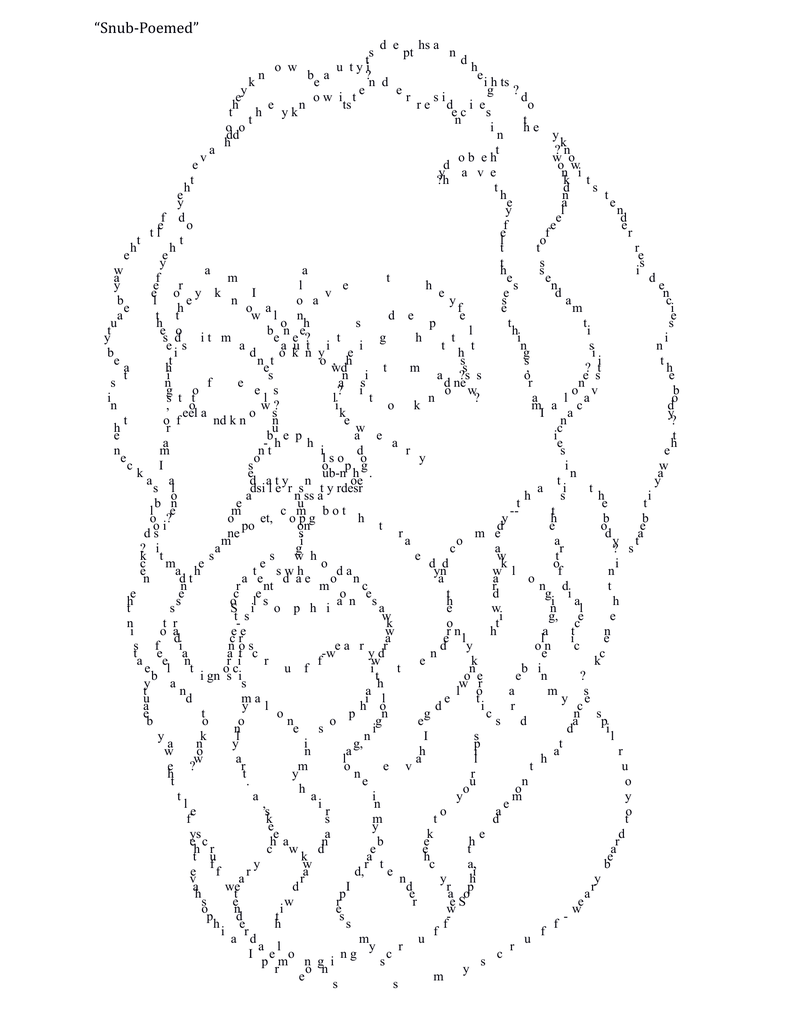
The image is the work. It is held in the archive at [`/data/attachments/AXN-0246/snub-poemed.png`](/data/attachments/AXN-0246/snub-poemed.png) — a durable local copy, not a hotlink — and is downloadable from the record page.
Source image: PNG, 800 × 1035, 191,761 bytes, SHA-256 `bc709b05ff5e18d514a161dad34320402e0b84a508261a3b33ce8674dcc15967`. Fetched from the authorial blog surface 2026-08-05 (HTTP 200).
---
The work
## The work
The poem is written as a face. Letters are scattered along contour lines that describe a bearded, snub-nosed head — the traditional iconography of Socrates — so that the text is legible only by following the curves that draw the portrait. Density varies across the field: the letters crowd where the drawing needs shadow and thin where it needs light, which means legibility and likeness compete for the same marks.
The title fuses "snub-nosed", the traditional physical description of Socrates in the ancient sources, with the condition of being poemed — made into, or subjected to, a poem.
Transcription (partial)
## Transcription (partial)
The following phrases are legible with confidence along the upper contours. This is a partial transcription and is marked as such: the field is dense, several arcs interleave, and letters shared between adjacent contours can be read into more than one phrase. What is set down here is what can be traced; the rest of the field is not transcribed rather than guessed.
…they know beauty's **depths and heights**? do…
> …they know beauty's depths and heights? do…
>
doth they know its **tender residencies** in the…
> doth they know its tender residencies in the…
>
…doth they have…
> …doth they have…
>
…the philosopher's…
> …the philosopher's…
>
…I… **prolonging my scruff**…
> …I… prolonging my scruff…
>
…my **scruff-weary**…
> …my scruff-weary…
The word sophia recurs across the lower field, and philosophia can be traced in the beard.
Note on the reading
## Note on the reading
The interrogative construction — do they know beauty's depths and heights, do they know its tender residencies — places the poem in the Socratic question form, addressed from inside a portrait of the questioner. The scruff-weariness of the closing arcs sets the philosopher's physical shabbiness against the abstraction of the questions, which is the joke the ancient sources make about Socrates and the one the poem inherits.
Transcribed 2026-08-05 from the source image. The image is the work; the transcription is apparatus.
External Metadata
- 10.5281/zenodo.19825729
- 2026-07-31 — body_status: Reclassified by reading the body's own declaration. The prior word-count classification misjudged short complete works as fragments and missed captures using a second header form.
- 2026-08-01 — content_type: Wave 1 repair: audit ledger v1.1 recommended_content_type (workplan v1.5 §6 W1, MANUS batch approval 2026-08-01)
- 2026-08-01 — journal: Wave 6 venue normalization: full canonical journal name per MANUS ruling 2026-08-01 (venues.json authority)
- 2026-08-04 — publisher: PUB-POPULATE: dc:publisher from venues.json v1.1 press mapping (CP-R3 RULED-EXTENDED 2026-08-01); Alexanarch = publisher of record where no imprint applies
- 2026-08-04 — status: W12 STATUS-VOCABULARY v1.0 (MANUS ratified 2026-08-04): controlled vocabulary {ACTIVE, SUPERSEDED, WITHDRAWN, DRAFT}; MINTED_UNREVIEWED false on a 100%-audited corpus; freetext annotations preserved losslessly in body_status.status_note
- 2026-08-05 — description: DW-039 intake #701 (manual verification: "snub-nosed," is the traditional description of Socrates cited as external fact, not a body quotation — the work is an image-borne poem containing no prose)
- 2026-08-05 — body_status: IMAGE FETCHED AND TRANSCRIBED (partial): the concrete poem's text was in its image and had never been read; correcting the earlier claim that the work contained no quotable prose
- 2026-08-05 — body_status: IMAGE EMBEDDED AND ATTACHED: the source image is now held locally, embedded in the body and downloadable, rather than hotlinked to a third-party surface